
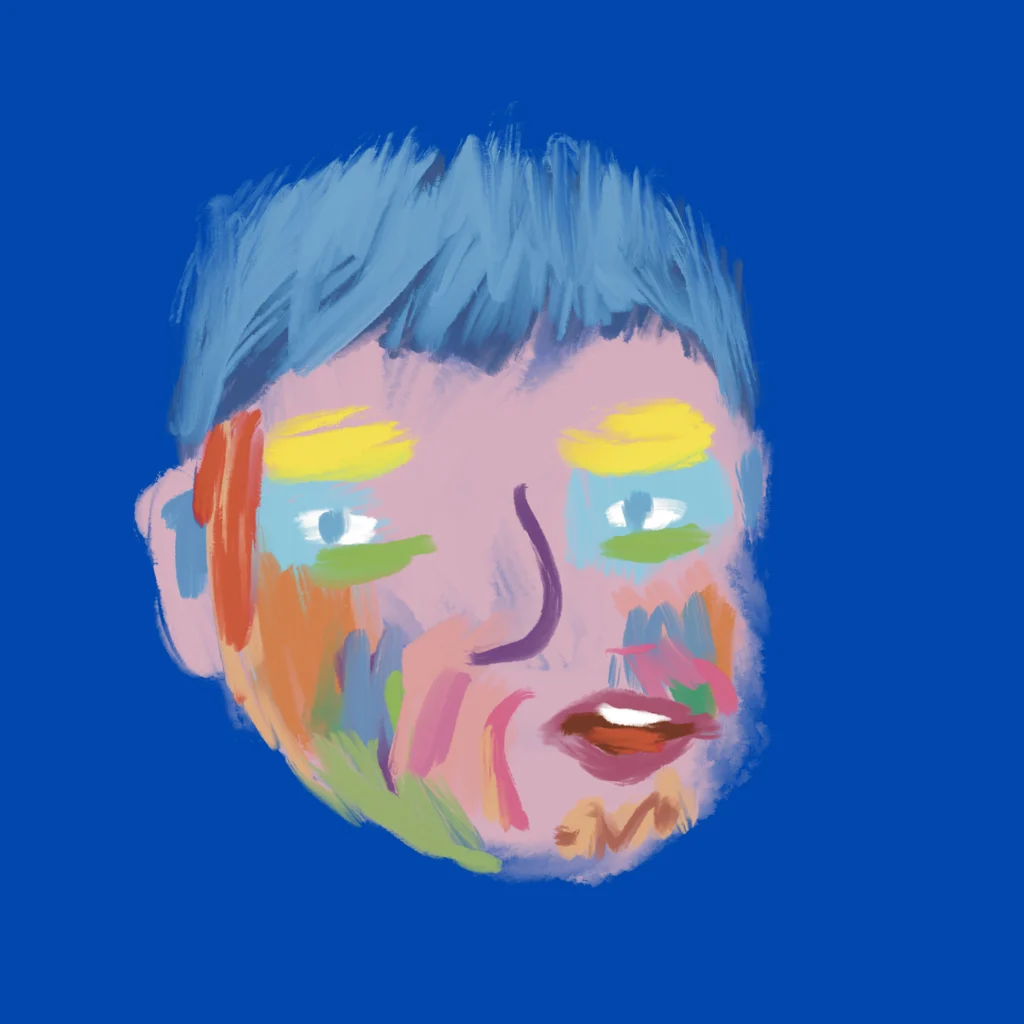
- Specimen
- EmoLog
- Category
- Product Design / Emotion Logging / Visual System
- Platform
- iOS / Android
- Core Idea
- Emotion coordinates instead of forced naming
- Assets
- 150+ original abstract emotion illustrations
- Role
- Solo Product Creator / Illustration / UX / UI / Frontend / Launch
EmoLog
EmoLog is one of my clearest examples of turning an abstract inner state into a usable product. The problem I wanted to solve was not simply “how to log a mood,” but what a product can do when someone clearly feels something yet cannot name it.
That is why I did not start from emotion lists or labels. Instead, I built a two-dimensional coordinate system using two more intuitive axes: bright vs. down and calm vs. intense. Users do not begin by choosing a word. They begin by moving through emotional space.
That decision matters because it reframes emotion from a language problem into a position problem. Many people do not lack feelings. They lack confidence about which word to choose. Swiping makes it easier to say, at minimum, “I am not exactly happy, but I am not overwhelmed either.”
Another major strength is that I did not rely on standard emoji or generic iconography. I drew my own semi-abstract faces. Their job is not to be literal. Their job is to give people enough ambiguity to project themselves into the image.
This is not just a collection of artworks. It is an emotion-recognition interface. Every face has to remain distinct, correspond to a coordinate region, work with the shifting background palette, and still feel like empathy rather than diagnosis.
Once users find the right face, the logging flow stays intentionally light. They can write a line, or not. They can keep only the face and coordinates, or attach time and weather too. The goal is reducing friction, because if logging starts to feel like diary homework, many people will stop.
That thinking is closely related to my iHealth health-visual work: I care not only about clarity, but also about memorability and shareability. EmoLog’s share card matters because it gives the product a built-in distribution behavior.
I also structured review in two different ways: Calendar for revisiting a specific day, and Distribution for observing emotional patterns as a landscape rather than a line chart. Again, this is about translating abstraction into a more understandable visual system.
Another choice I cared deeply about was lowering psychological cost: no account required by default, local-first data storage, and no paywall around the core experience. This is a companion product, so the product should not burden people before it helps them.
EmoLog did not stop at “art for emotions.” I translated it into coordinates, gestures, faces, background color logic, logging, sharing, calendar review, distribution views, and storage rules until it became a real product.
EmoLog does not begin by forcing users to name a feeling.
It begins by helping them find a face and a position where that feeling can first be held.