- Specimen
- Different Eyes
- Category
- Wearable Object / Perception Study / Laser Cut
- Material
- Rotating boxes / 45-degree mirrors / wearable frame
- Focus
- Side vision / disorientation / embodied perception
- Field Note
- The world changes when the eyes are relocated
- Collector
- Daco
Different Eyes
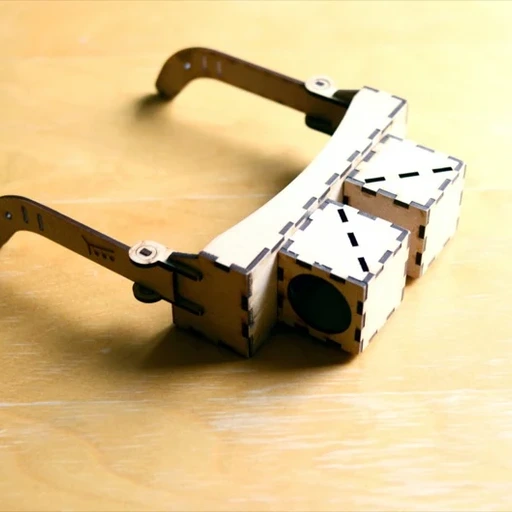
Different Eyes is a laser-cut wearable perception device, and one of the earliest works where I began treating perception itself as a design material.
I designed two small rotating boxes in front of the glasses, each holding a mirror at a 45-degree angle. Once worn, the user’s forward-facing sight is redirected sideways. As the boxes rotate, the two eyes can even be sent toward different directions, producing a mode of seeing that does not fit ordinary human visual habit.
What if our eyes were not placed on the front of the face,
but more like birds, horses, or other animals
whose sight extends from the sides?
Humans rely on forward-facing vision to understand space. Our sense of direction, distance, movement, and what counts as “ahead” are all built on that default structure. When vision is forced to shift, split, or turn away, the body hesitates almost immediately, and familiar judgment becomes unstable.
I was not trying to simulate a specific animal precisely, nor to design a more useful pair of glasses. I wanted to create an experience between understanding and imbalance. If we briefly leave our ordinary sensory habit, how does the body search for orientation again? Does the world begin to feel different?
To me, Different Eyes is not just a special pair of glasses. It is a tool that makes seeing feel strange. It reminds people that seeing is never purely neutral or objective. A large part of what we call reality is shaped by bodily limitation, position, and habit.
This work later shaped how I understand design and products. I became more interested in how a product can become a way of seeing the world. TreeGo changes how people notice trees in the city. DriftGo changes how people imagine movement and encounter. Poemeet changes how strangers recognize each other before appearance takes over. EmoLog turns emotion into something that can be revisited and understood.
If we change the way we look,
does our relationship with the world change too?
That is why I am not interested only in making things easier or more efficient. Sometimes design is not about smoothing the world. Sometimes it is about stepping outside habit for a moment, borrowing another set of eyes, and looking again. Different Eyes feels like the beginning of that line of thought for me.